Daddy Mendelssohn is complicated.
Among people with a passing familiarity with Fanny Hensel, if they know one fact about her father Abraham, it is that he forbade his daughter from pursuing a career in music, telling her that while Felix would perhaps be a pro, for Fanny, music could only be an “ornament” to her life, never the foundation of who she was.
But that’s not actually what he said.
Most surface-level mentions of Abraham in the context of Fanny’s life paint him as the domineering father who forbade his daughter to pursue or find purpose in music, while actively supporting the musical career of her younger brother. The evidence for the bad-father accusation is an oft-quoted letter Abraham wrote to his 14-year-old daughter Fanny as her 11-year-old brother Felix’s musical opportunities began to outpace her own. Referring to Felix, Abraham writes:
“Die Musik wird für ihn vielleicht Beruf, während sie für dich stets nur Zierde, niemals Grundbaß deines Seins und Thuns werden kann und soll.”
English translation by Hensel’s biographer R. Larry Todd:
“Music will perhaps become his profession, whilst for you it can and must only be an ornament, never the root of your being and doing.”
A sad message to receive for a wildly talented young woman for whom music was already the root of her being and doing.
But it turns out this quote–maybe the most frequently cited thing Abraham wrote–has been incorrectly replicated for 150 years. It mischaracterizes his sentiment and needs context to be fully understood.
This quote has caused many a casual summarizer of Fanny’s biography to cast Abraham as the antagonist in her narrative arc, but if you’re looking for a clear “bad guy” in the story of Fanny’s life, it’s not him. It’s not any single person. And it’s probably best to stop looking for tidy narrative arcs in the lives of real people.
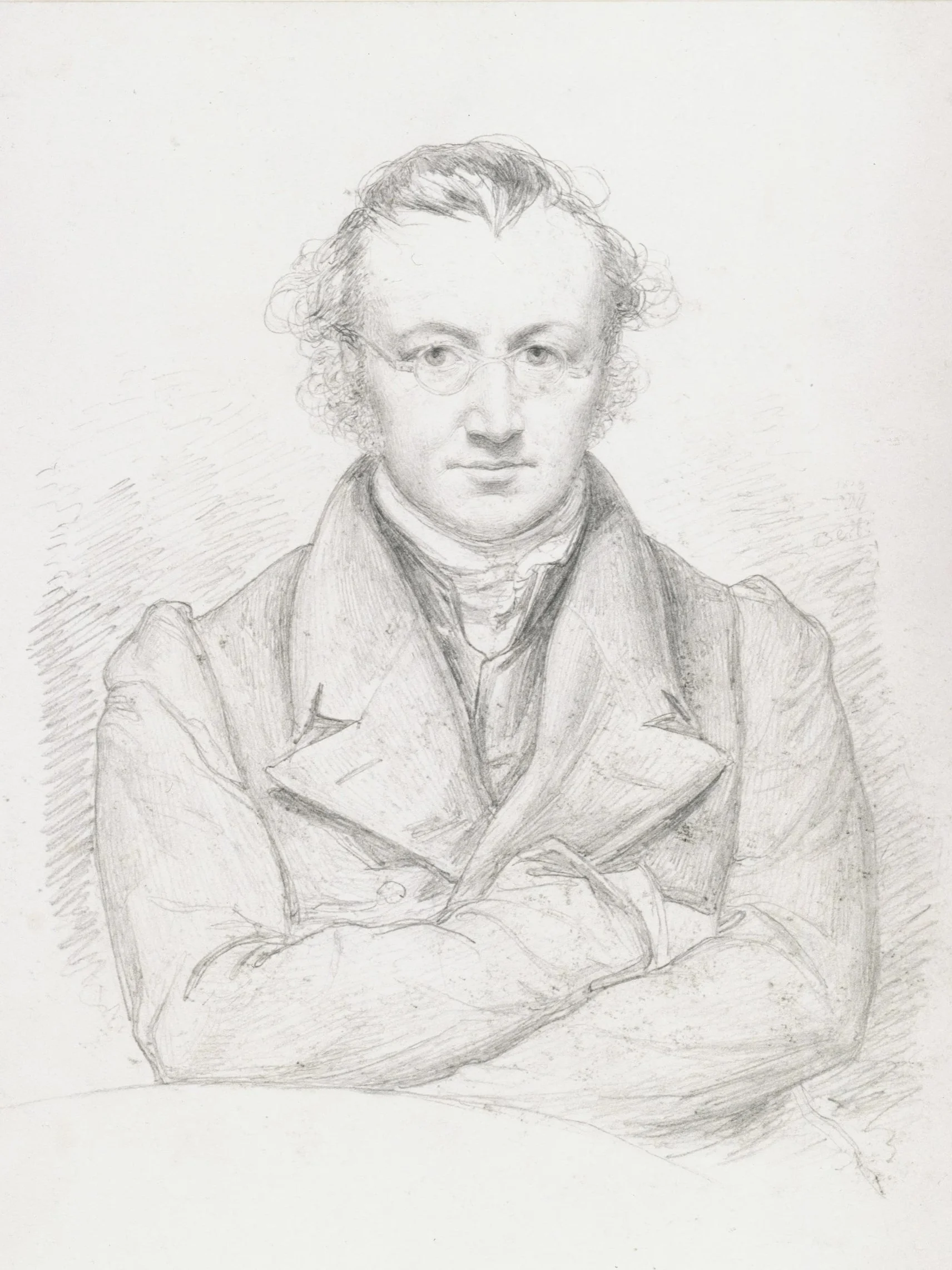
Abe, illustrated by Fanny’s husband Wilhelm Hensel.
Who was Abraham?
Abraham Mendelssohn-Bartholdy was born in Berlin in 1776.
Son of Moses Mendelssohn
Abraham’s father, Moses Mendelssohn, was an Enlightenment philosopher and one of the most important Jewish figures in European history. Moses advocated for the integration of Jews into Prussian culture and society, and was very well respected by both Jewish and Christian thinkers of his day. Moses valued education extremely highly, and so Abraham and his many siblings all received a liberal education.
Father of Felix & Fanny
Abraham was also, of course, father of two of the greatest musical minds of the 19th century: Felix Mendelssohn and Fanny Hensel (née Mendelssohn). While Fanny’s musical genius was not widely recognized for nearly 150 years after her death, Felix was a notable and successful composer and conductor during his lifetime, and Abraham anticipated his son’s importance in the musical sphere from a very young age. Abraham referred to himself with humor and humility as once the son of a famous father, then the father of a famous son.
Francophile
Abraham was a Francophile, influenced by his time living in Paris while training to be a bank clerk during Napoleon’s reign as First Consul in the last years of the 18th century. That was a time of dramatic social and political changes in the milieu of the Enlightenment principles of truth, reason, equality, and religious tolerance. Abraham saw French Jews who were legally full citizens, which was still more than a decade away back home in Berlin.
Banker & musical dilettante
After returning to Berlin, Abraham founded a bank in Berlin with his older brother Joseph, and married Lea Solomon, who came from another very highly educated and prominent Jewish family (and Lea’s family was far wealthier). Lea, like her mother and aunts, was a serious musician and disciple of the music of J.S. Bach. Abraham was a more casual appreciator of music.
Context of the Letter
The family converts amid rising antisemitism
The Aufklärung (German Enlightenment) that Abraham and Lea had grown up and thrived in was over by the time their children were coming of age. Society had taken a sharp turn toward conservatism, which meant the role of women was more constrained for Fanny and her sister Rebecka than it had been for Lea and the previous generation of women. Prussian women were not expected to aspire to anything beyond motherhood, and certainly not anything in the public eye.
This conservative turn in society was accompanied by rising antisemitic violence and sentiment across the German states. In 1819 (the year before the letter was written), after an incident where 10-year-old Felix was the target of antisemitic comments in the street, Abraham and Lea even briefly considered relocating the family to Paris.
This was the context for Abraham and Lea’s decision that their children should convert to Christianity. In their minds it was the best way to provide young Fanny, Felix, Rebecka, and Paul with social acceptance and opportunities in life.
Conversion to Protestantism was not an unprecedented decision; both Abraham and Lea had family members who became Christian converts (some even Catholics!), but it did come at a cost; the decision caused conflict with some of the older family members who remained in the Jewish faith.
Fanny and her three younger siblings converted to Lutheranism in the summer of 1820, and Abraham and Lea converted later, at which point they added “-Bartholdy” to their surname to sound more gentile.
Here is an excerpt from another letter Abraham wrote to Fanny about his views on Christianity and their family’s conversion, also from July 1820 (transl. Todd):
“Does God exist? What is God? Is He a part of ourselves, and does He continue to live after the other part has ceased to be? And where? And how? All this I do not know, and therefore I have never taught you anything about it. But I know that there exists in me and in you and in all human beings an everlasting inclination towards all that is good, true, and right, and a conscience which warns and guides us when we go astray. I know it, I believe it, I live in this faith, and this is my religion.... The outward form of religion your teacher has given you is historical, and changeable like all human ordinances. Some thousands of years ago the Jewish form was the reigning one, then the heathen form, and now it is the Christian. We, your mother and I, were born and brought up by our parents as Jews, and without being obliged to change the form of our religion have been able to follow the divine instinct in us and in our conscience. We have educated you and your brothers and sister in the Christian faith, because it is the creed of most civilized people, and contains nothing that can lead you away from what is good, and much that guides you to love, obedience, tolerance, and resignation, even if it offered nothing but the example of its Founder, understood by so few, and followed by still fewer.”
Abraham and Lea’s goal was that their children fit seamlessly into Prussian society. Being Christian was a prerequisite, but fitting into society also required conforming rigidly to conservative post-Aufklärung Prussian gender norms. Performing music publicly, especially for money, was inappropriate for women of their class, carrying deep-rooted associations with sex work. As former Jews, the family was under extra scrutiny and had to conform more closely to societal expectations than their Christian neighbors. So from Abraham’s perspective, allowing Fanny to break these gender norms and pursue music fully would have defeated the purpose of the family’s conversion and resulted in social ostracism and a narrowing of options for their children. This is the context in which Abraham wrote to Fanny about the role of music in her future.
Abraham’s actual words
The discovery that this famous quote was corrupted was written up earlier this year by Susanne Wosnitzka and feministisch.unterrichten in two German language Instagramposts that also cite research by Thomas Hennig. Thanks to them for surfacing this misconception; I have not done this research myself, I’m only trying to help spread their good work by sharing the findings in English.
Again, here is the widely-known, corrupted version of Abraham’s words: (I’m preserving his original, now-outdated spelling)
INCORRECT QUOTE:
“Die Musik wird für ihn vielleicht Beruf, während sie für dich stets nur Zierde, niemals Grundbaß deines Seins und Thuns werden kann und soll.”
English translation:
“Music will perhaps become his profession, whilst for you it can and must only be an ornament, never the root of your being and doing.”
In the letter, Abraham uses words with musical double-entendres in order to speak in terms Fanny will understand metaphorically:
“Zierde” is translated as “ornament”, and can mean “adornment” or “decoration”, but can also be used in the same way as the English word “ornament” is used in music: to describe trills, mordents, turns, etc.
“Grundbaß” is translated as “root”, but could also mean “foundation”, and its musical meaning is “fundamental bass” which Rameau coined to refer to the sequence of root notes in a chord progression.
Here are Abraham’s actual words:
ACTUAL QUOTE:
“Die Musik wird für ihn vielleicht Beruf, während sie für dich stets nur Zierde, immer Bildungsmittel, Grundbaß deines Seins und Thuns werden kann und soll.”
English translation:
“Music will perhaps become his profession, whilst for you it can and must only be an ornament, always a means for self-cultivation, the root of your being and doing.”
Edits to Abraham’s words:
The first way the quote was changed is the word “immer”/“always” was replaced with the word “niemals”/“never”, inverting the meaning of Abraham’s invocation of “Grundbaß”/“fundamental bass”. Abraham actually said music should always be the root of Fanny’s being and doing.
The other intervention in the quote is the complete removal of the word “Bildungsmittel”. “Mittel” can be translated as “medium” (n.), “means” (n.), or “resource”, and “Bildung” is the German concept of self-cultivation, personal growth and development, and lifelong learning (think of the literary genre Bildungsroman). Abraham told Fanny that music is the medium through which she will learn and develop as a person.
The corrupted quote uses the musical terms “Zierde” and “Grundbaß” in opposition to each other; intending that whereas Felix’s relationship to music can be fundamental and foundational to his identity, Fanny’s can only be superfluous and decorative. But in Abraham’s actual meaning, these concepts are not set up as antonyms, and he is not forbidding his daughter from engaging in music—he uses musical metaphors to articulate his hopes for his child’s future.
The corrupted version of the quote makes it seem like Abraham was forbidding Fanny from finding deep meaning and purpose in music, distorting his values/beliefs, and therefore his relationship with his daughter. But in his letter, he was not dismissing the importance of music in her life; he was affirming it.
None of this changes the fact that, despite recognizing and appreciating her immense talent, Abraham’s purpose was to inform Fanny that she could never have the career in music that her brother could. It’s horrible that she was so constrained by circumstances, but oversimplifying all of the context you’ve read so far into “her father dismissed her pursuit of music” is insulting to the complexity of the situation. The oppressively patriarchal and antisemitic society the family lived in was to blame, not any individual in the family. Abraham and Lea may not have made the best decision, but they were put in a very difficult situation and did what they believed best for their children.
How did the letter get misquoted?
The corrupted version of this quote seems to originate almost 150 years ago in a book written by Fanny’s son Sebastian Hensel. Sebastian was 16 when his mother died suddenly of a stroke. His uncle Felix died less than 6 months later, also of a sudden stroke.
In his later years, Sebastian wrote a book about the family: Die Familie Mendelssohn (1729-1847)—those being the years of Moses’s birth and of Fanny and Felix’s deaths, respectively. The book consists primarily of long excerpts from family letters and journals.
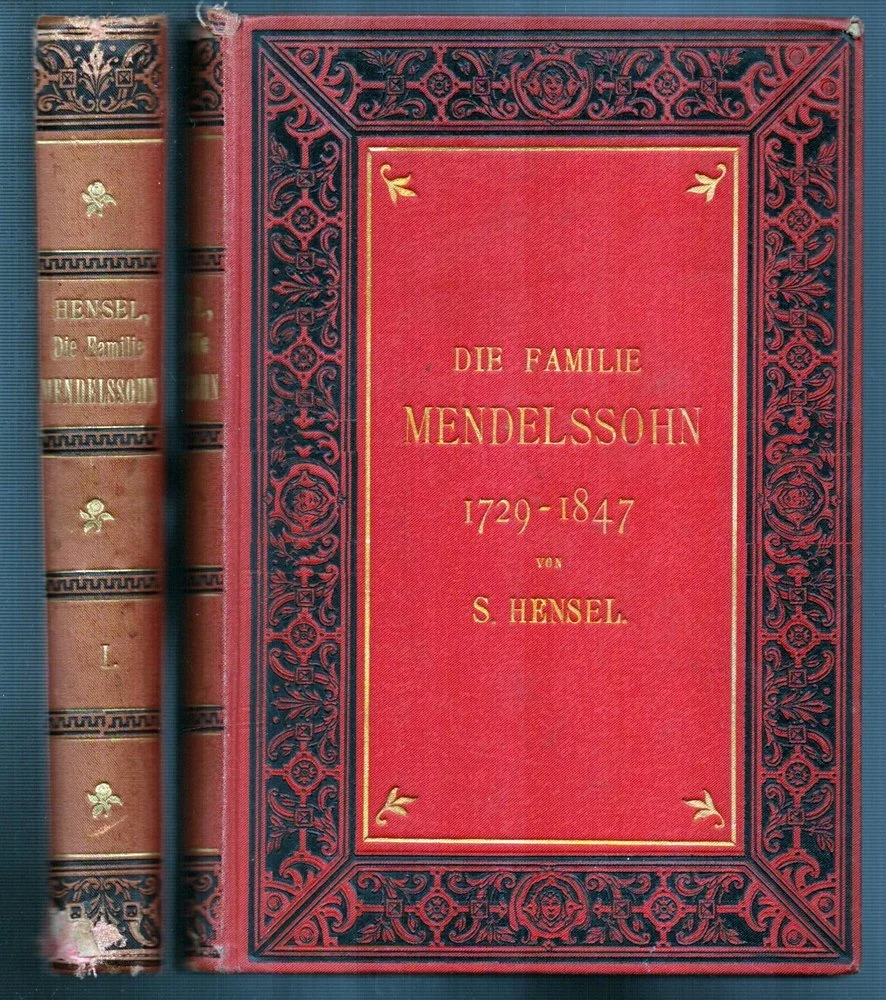
Die Familie Mendelssohn was first published in German in 1879 and was soon released in English translation. Both language versions have been released in many many editions since then, all preserving and proliferating this corrupted version of the quote.
Because the book was so widely available and because Sebastian was presumed to be a trustworthy source, researchers and biographers never questioned the validity of the quote, and so replicated it further.
What was Sebastian doing?
So did Sebastian make a mistake when transcribing the letter? I don’t think so; the edits are too pointed to be honest errors. The deletion of an important word and the replacement of an adverb with its antonym does not seem like it would have happened accidentally.
Sebastian, like his grandfather Abraham several decades earlier, was attempting to preserve the image of the family as good (patriarchal) Christian Prussians in the midst of once-again-rising antisemitism, this time aimed explicitly at Felix and his legacy.
Only a few years after Felix’s death, absolute-shitsmear-of-a-human Richard Wagner pseudonymously published the hateful pamphlet Judaism in Music, in which he argued that Felix’s music lacked depth because of his Jewish blood (rendering his childhood conversion to Christianity irrelevant). Wagner later expanded his detestable screeds into a book and published it under his real name in 1869. Wagner’s vitriol resonated with antisemitic sentiments in many Germans of the time, and Felix, one of the most performed composers in Europe around the time of his death, had his music programmed less and less.
This was the context in which Sebastian published Die Familie Mendelssohn. The book was a chronicle of the family, but also had a public relations purpose: to humanize the Mendelssohns, and portray them as an exemplary German family. That meant casting Abraham as a strong traditional patriarch who demanded his daughter focus only on motherhood and not on music. Abraham’s actual words were seemingly not strong enough, in Sebastian’s view, to project that dominance. So, I suspect that Sebastian consciously changed his grandfather’s words.
From Sebastian’s perspective, this revision could also have been a way of protecting the reputation of his mother—by making her look like a good Christian German woman who followed the instruction of her father and dutifully abandoned her pursuit of music to be a devoted wife and mother. (If you read Die Familie Mendelssohn, you’ll notice Fanny’s musical activities, particularly her composing, are scarcely mentioned.)
Why the corrupted quote sticks
Nearly a quarter century ago, Marian Wilson Kimber wrote about the challenge of feminist biography using Fanny Hensel as a lens, arguing that most modern biographies of Hensel project onto her a sense of frustration with her situation that the evidence does not unambiguously support. “The tone of much contemporary writing about Fanny Hensel reflects a personal identification and a modern woman’s wish to save her from her historical situation and cultural context.”(1)
When I encounter casual retellings of Fanny Hensel’s story, as I very frequently do, I am so often struck by how oversimplified and exaggerated the characterizations are. I almost always see the emotional projection of the author that Marian Wilson Kimber writes about. But on an even more basic level, I see the characters in the story—once real, living, nuanced people—contorted into caricatures to force the story into a recognizable, even pat narrative arc that can be transmitted in a couple sentences… into the familiar format that our brains need to consume and process these stories.
We need for there to be a beginning, middle, and end; and we like a dramatic throughline and clear, recurring themes. It’s just the way we are accustomed for stories to be structured. But real people are never this simple. Real lives are messy and lack cohesion; real relationships are complex; real individuals' complete lives do not fit into the rigid story structure we force onto them. Even when we’re not intentionally propagandizing using someone’s biography, we are flattening the people and situations of the past to tell a good, concise, character-driven story.
. : ~ * • ° People's lives are too complex to fix neatly into a narrative arc, and things will be misrepresented if you try. ° • * ~ : . We also need a hero and a villain, so Fanny’s journey becomes the quest to fully self-actualize through music—or maybe the quest to publish music under her own name—and Abraham (and later Felix) gets framed as a villain, having callously and tyrannically forbidden her from achieving her quest. As individuals, these men are more convenient villains than diffuse systems like antisemitism and patriarchy are.
The corrupted version of the quote makes Abraham a tidier villain, which may be why it has circulated so widely. For this reason, I don’t think the corrupted version of the quote is going away. It’s too sticky narratively. Abraham will remain the bad guy, and correcting the record on what he actually said will become another of my Sisyphean undertakings, like fixing the issue of Cécile’s image being used as Fanny on the internet (which Marian Wilson Kimber has also written about.)
(1) Marian Wilson Kimber, “The “Suppression” of Fanny Mendelssohn: Rethinking Feminist Biography”, 19th-Century Music, XXVI (2002), 126.
Abraham and Fanny’s Music
In conclusion, Abraham loved and cared for his children. He recognized and appreciated their talent. And it’s a tragedy that Fanny’s career in music was forbidden by her father. Making Abraham (and later Felix) the “bad guy” in the story of Fanny’s life does an injustice to the complex nature of existing with intersectionally marginalized identities in an oppressive society.
The truth is that we have many touching examples of Abraham and Fanny’s shared musical experiences: one of Fanny’s earliest recorded musical achievements was when at age 13 she performed all 24 preludes from Bach’s Well-Tempered Clavier from memory. The occasion was Abraham’s birthday.
I’ll end with this: the lyrics of “Ihr Töne schwingt euch fröhlich” (H2), Fanny’s earliest surviving composition, written for her father:
O notes, soar joyfully through the strings,
Ring out brightly today;
You shall herald a song of jubilant praise,
Offered by the loving hearts of children.Outside, an icy, gloomy veil
Shrouds the fields' colorful splendor;
Yet for us, a joyful celebration blooms
Right here in the dark of winter's night.How faithfully he watches over our circle,
The cherished guardian of our home,
Unfolding new love for us each day,
Ever thoughtful and ever active.So may a friendly, bright star
Continue to shine upon his precious life;
Long may his guardian spirit attend him,
And may all harm remain far away.But you, o notes, soar through the strings,
Ring out louder today;
You shall herald a song of jubilant praise,
Offered by the love of his children.
You can access the sheet music for free thanks to the work of Tim Parker-Langston over at henselsongsonline.org.